

How To Clear Screen In Mysql Command Prompt
2
Using SQL*Plus
This chapter explains how to start and use SQL*Plus from the command line interface and the graphical user interface, and describes the menu options.
Specific topics discussed are:
- Using the Command Line Interface
- Using the Graphical User Interface
- Using SQLPLUS.EXE
Using the Command Line Interface
The command line interface is a standard feature of SQL*Plus for all platforms.
To start the command line interface:
- If you are connecting to a remote Oracle database, make sure your SQL*Net/networking software is installed and working properly.
- Start an MS-DOS command prompt window.
- At the command prompt, enter:
SQLPLUS [username/password][@connectstring]
For Windows NT/95, the rules for interpreting arguments are:
- Arguments are delimited by white space.
- A string surrounded by double quotation marks (for example, "string") is interpreted as a single argument.
- A double quotation mark preceded by a backslash is interpreted as a literal double quotation mark.
Using the Graphical User Interface
The graphical user interface is a feature of SQL*Plus for Windows NT/95.
To start the graphical user interface:
- If you are connecting to a remote Oracle database, make sure your SQL*Net/networking software is installed and working properly.
- Choose Start > Programs > Oracle for Windows NT [HOME_NAME] (or Oracle for Windows 95 [HOME_NAME]) > SQL Plus 8.0.
The Log On dialog box appears.
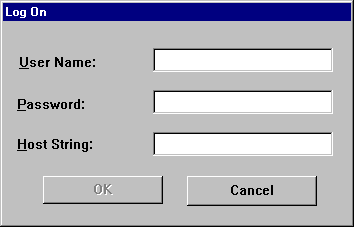
- Enter your user name and password. If you are connecting to a remote Oracle database, enter the SQL*Net connect string.
- Click OK.
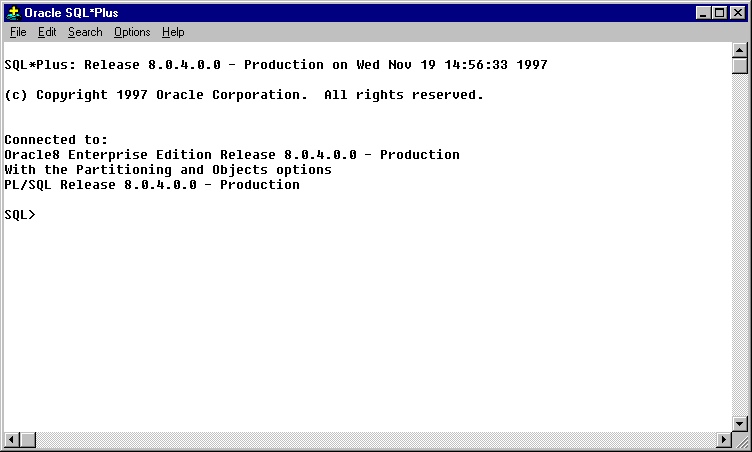
The SQL*Plus application window appears.
Using the SQL*Plus Application Window
SQL*Plus displays the SQL prompt in the application window.
To enter SQL and SQL*Plus commands, type them at the SQL prompt and press Enter.
Using the Mouse Buttons to Copy SQL Commands in the Application Window
You can use the mouse buttons to copy previously entered SQL commands to the current SQL prompt.
- To copy a command, highlight it with the left mouse button. While still holding down the left mouse button, click the right mouse button.
SQL*Plus copies the text to the SQL prompt.
Using the Command Keys
The following command keys have special functions in SQL*Plus:
| Key | Function |
|---|---|
| Home | Top of screen buffer |
| End | Bottom of screen buffer |
| Page Up | Previous screen page |
| Page Down | Next screen page |
| Ctrl+Page Up | Show page on left of current screen page |
| Ctrl+Page Down | Show page on right of current screen page |
| Alt+F3 | Find |
| F3 | Find next |
| Ctrl+C | Copy text |
| Ctrl+V | Paste text |
| Shift+Del | Clear the screen and the screen buffer |
Using the SQL*Plus Menus
This section describes the five menus in SQL*Plus.
File Menu
The File menu contains the following commands:
| File Menu Command | Description | Command Line Equivalent |
|---|---|---|
| Open | The Open command retrieves a previously stored command file. By default, SQL*Plus looks for a command file with the .SQL extension. | not applicable |
| Save | The Save command contains three subcommands: Save Create, Save Replace, and Save Append. | SAVE |
| SAVE filename CREATE | |
| SAVE filename REPLACE | |
After you save a command file, you can do the following:
| SAVE filename APPEND | |
| Save As | The Save As command saves the contents of the SQL*Plus buffer in a command file. By default, SQL*Plus assigns the .SQL extension to command files. You can specify a different extension in the File name text box. | SAVE filename |
| Spool | The Spool command contains two subcommands: Spool File and Spool Off. | |
| SPOOL filename | |
| SPOOL OFF | |
| Run | The Run command lists and executes the SQL command or PL/SQL block currently stored in the SQL buffer. | RUN |
| Cancel | The Cancel command cancels an in-progress operation. Ctrl+C is the keyboard shortcut for the Cancel command. | not applicable |
| Exit | The Exit command commits all pending database changes and closes the SQL*Plus application window. | EXIT |
Edit Menu
The Edit menu contains the following commands:
| Edit Menu Command | Description | Command Line Equivalent |
|---|---|---|
| Copy | The Copy command copies the selected text to the Clipboard. After you copy text to the Clipboard, you can paste the text into other Windows applications, such as Microsoft Excel and Microsoft Word. Ctrl+C is the keyboard shortcut for the Copy command. | not applicable |
| Paste | The Paste command pastes the contents of the Clipboard onto the SQL*Plus command line. Ctrl+V is the keyboard shortcut for the Paste command. Note: A maximum of 3625 characters can be pasted from the Clipboard onto the SQL*Plus command line during a single paste operation. | not applicable |
| Clear | The Clear command clears the screen of the SQL*Plus application window and the screen buffer. Shift+Del is the keyboard shortcut for the Clear command. | CLEAR SCREEN |
| Editor | The Editor command contains two subcommands: Invoke Editor and Define Editor. | |
| EDIT | |
| not applicable |
Search Menu
The Search menu contains the following commands:
| Search Menu Command | Description | Command Line Equivalent |
|---|---|---|
| Find | The Find command searches for a character, a word, or a group of characters or words in the SQL*Plus application window. When you choose the Find command, SQL*Plus begins the search at the top of the displayed screen. Note: When SQL*Plus reaches the end of the displayed screen, it will not automatically continue searching from the top of the SQL*Plus screen buffer. ALT+F3 is the keyboard shortcut for the Clear command. | not applicable |
| Find Next | The Find Next command finds the next occurrence of the search text. F3 is the keyboard shortcut for the Clear command. | not applicable |
Options Menu
The Options menu contains the following command:
| Options Menu Command | Description | Command Line Equivalent |
|---|---|---|
| Environment | The Environment command allows you to set system variables to alter the SQL*Plus environment for your current session. The Environment dialog box contains two areas: Set Options and Screen Buffer. | SET variable value |
| Set Options This area contains a list of variables you can choose in order to establish aspects of the SQL*Plus environment for your current session, such as the following:
You can make multiple changes to options before clicking OK to commit the changes. | ||
| To establish an aspect of the SQL*Plus environment:
| ||
| Screen Buffer When you change the Screen Buffer option, SQL*Plus displays a dialog box to alert you that if you shorten the size of your screen buffer, some data may not be displayed on your screen. Click OK if you want to proceed. | ||
| The Screen Buffer area consists of two text boxes: Buffer Width and Buffer Length.
|
Help Menu
The SQL*Plus application does not contain online help. However, the CD-ROM contains the following documentation in both HTML and PDF format:
- SQL*Plus User's Guide and Reference
- SQL*Plus Quick Reference
- SQL*Plus Getting Started Release 8.0.4 for Windows NT and Windows 95 (this guide)
The Help menu does contain one command:
| Help Menu Command | Description | Command Line Equivalent |
|---|---|---|
| About SQL*Plus | Displays the version number and copyright information. | not applicable |
Using SQLPLUS.EXE
SQLPLUS.EXE is used to spawn any SQL*Plus executable that is defined in the PLUS_DFLT parameter located in the registry.
SQLPLUS.EXE allows you to run any specified version and mode of SQL*Plus when it is started. You can modify the value of PLUS_DFLT, thereby having SQLPLUS.EXE spawn the desired version and mode of SQL*Plus.
By default, PLUS_DFLT is set to the last version of the command line interface of SQL*Plus installed.
How To Clear Screen In Mysql Command Prompt
Source: https://docs.oracle.com/cd/A59447_01/nt_804ee/doc/sqlplus.804/a55973/ch2.htm
Posted by: goodingpold1960.blogspot.com
0 Response to "How To Clear Screen In Mysql Command Prompt"
Post a Comment