

How To Cite The Clean Air Act
Well-nigh everything humans practise, from growing food to manufacturing products to generating electricity, has the potential to release pollution into the environment. Regulatory agencies charged with protecting the environment identify two main categories of pollution: point-source and nonpoint-source pollution. Bespeak-source pollution is easy to identify. As the proper noun suggests, it comes from a single place. Nonpoint-source pollution is harder to identify and harder to accost. It is pollution that comes from many places, all at once. The United States Environmental Protection Bureau (EPA) defines betoken source pollution as any contaminant that enters the surround from an easily identified and confined place. Examples include smokestacks, discharge pipes, and drainage ditches. Factories and power plants tin be a source of betoken-source pollution, affecting both air and water. Smokestacks may spew carbon monoxide, heavy metal, sulfur dioxide, nitrogen dioxide, or "particulate thing" (small particles) into the air. Oil refineries, paper mills, and auto plants that use water as part of their manufacturing processes can discharge effluent—wastewater containing harmful chemical pollutants—into rivers, lakes, or the ocean. Municipal wastewater treatment plants are another mutual source of betoken-source pollution. Effluent from a treatment plant tin introduce nutrients and harmful microbes into waterways. Nutrients tin can crusade a rampant growth of algae in water. Nonpoint-source pollution is the opposite of point-source pollution, with pollutants released in a broad area. As an example, picture a city street during a thunderstorm. As rainwater flows over asphalt, information technology washes away drops of oil that leaked from auto engines, particles of tire safety, dog waste material, and trash. The runoff goes into a storm sewer and ends upward in a nearby river. Runoff is a major cause of nonpoint-source pollution. It is a big problem in cities because of all the hard surfaces, including streets and roofs. The amount of pollutants washed from a unmarried metropolis block might be pocket-sized, but when you add upwardly the miles and miles of pavement in a big city y'all get a big problem. In rural areas, runoff can wash sediment from the roads in a logged-over forest tract. Information technology can also carry acid from abandoned mines and affluent pesticides and fertilizer from farm fields. All of this pollution is likely to wind upward in streams, rivers, and lakes. Airborne pollutants are major contributors to acrid pelting. It forms in the atmosphere when sulfur dioxide and nitrogen oxides combine with h2o. Considering acid pelting results from the long-range movement of those pollutants from many factories and power plants, it is considered nonpoint-source pollution. In the United States, the Clean Air Deed and the Clean Water Act have helped to limit both point-source and nonpoint-source pollution. Cheers to these ii legislative initiatives, in event for some fifty years now, America'south air and water are cleaner today than they were for nearly of the 20thursday century.
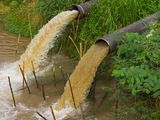
Waste filled water is dumped into a river, polluting it for the people and animals who apply it as a source for eating and drinking.
Photograph past Kaentian Street
Noun
community and interactions of living and nonliving things in an area.
effluent
Noun
liquid waste material that is thrown into a river or sea.
emission
Noun
belch or release.
Noun
oral cavity of a river where the river'southward current meets the sea'due south tide.
fertilizer
Noun
nutrient-rich chemic substance (natural or manmade) applied to soil to encourage constitute growth.
legislation
Noun
law, legal deed, or statute.
nitrogen
Noun
chemical element with the symbol Due north, whose gas form is 78% of the Earth's temper.
nonpoint-source pollution
Noun
toxic chemicals that enter a body of water from many sources.
Noun
substance an organism needs for energy, growth, and life.
pesticide
Noun
natural or manufactured substance used to kill organisms that threaten agriculture or are undesirable. Pesticides can be fungicides (which kill harmful fungi), insecticides (which impale harmful insects), herbicides (which kill harmful plants), or rodenticides (which kill harmful rodents.)
phosphorus
Substantive
chemical element with the symbol P.
betoken-source pollution
Noun
pollution from a single, identifiable source.
Substantive
introduction of harmful materials into the environment.
Substantive
overflow of fluid from a farm or industrial factory.
Noun
solid material transported and deposited by water, ice, and wind.
sewage
Noun
liquid and solid waste material from homes and businesses.
thermal pollution
Noun
reduction of water quality through the change of ambient water temperature.
wastewater
Substantive
water that has been used for washing, flushing, or industry.

Source: https://www.nationalgeographic.org/encyclopedia/point-source-and-nonpoint-sources-pollution/
Posted by: goodingpold1960.blogspot.com
0 Response to "How To Cite The Clean Air Act"
Post a Comment